Category: Blog

  • Sustainable Business or No Business.

    Sustainable Business or No Business.

    Ailsa Huerta-Castro is a University of Oregon student with a minor in Sustainable Bussiness. Her passion for environmental research and climate conservation motivates her to be an informed and sustainable global citizen. As a Gen Z climate activist, Ailsa appreciates the intersection of climate change research and proactive social media messaging–she uses both in her position as social media manager for the UO flea market.

    The UO flea market is a student-run organization that has put on sustainable buying and selling events on University of Oregon’s campus since their start in 2024. You can visit the UO Flea Market Instagram page to find out more about how they’re impacting the culture of sustainability on campus and stay updated on future events!

    Make-Or-Break Sustainability: Why brand transparency is more important than ever

    Why does Gen Z care so much about sustainability?

    “I feel like part of the reason why our generation really cares about it is because we have so much information accessible to us and were able to see the real life impact climate change has on the earth and I feel like that awareness has made us want to take action. Also just knowing that it’s going to affect us in our lifetime whereas our parents and our grandparents, they’re not as affected by it but it’s something that we’re going to have to face.”

    How has Gen Z cancel culture changed the standard for brand CSR?

    “Again, with the fact that so much information is available to us and people are able to openly state their opinions online whether it’s through a post or a tweet or a video and I think in a way that forces brands to be on top of CSR. With social media platforms it’s a lot easier for people to communicate how they feel about a brand, especially when the brand is going against their values; I think that because of that brands are forced to step up.”

    How do you decide what brands are trustworthy?

    “In my own personal life, I decide what brands are trustworthy based off of the things that they stand for, especially any organizations that they contribute some of their profits to. For example, Patagonia. I know that a lot of the money that they make is given to organizations that are actively working against climate change. It’s really fulfilling to know that the money that I’m investing into a company is going towards a greater good.”

    How do you incorporate slow fashion and secondhand consumerism into your life?

    “I love this question! I think we live in an era where we’re kind of forced to be consuming things all of the time and trends are cycling so much faster than they ever have before so there’s definitely this pressure to have constantly have something new. I think thrifting and shopping secondhand helps to combat that.”

  • Intro to Infographics (and How to Spot a Good One).

    I find myself drawn to posters of bands and musical artists. Some visually interesting graphic design categories include genres of movie posters, fashion advertisements, advocacy flyers to name a few. Other avenues of visual communication include street signs and public information signage. These kinds of visual messages are usually less focused on the aesthetic element of the graphic and more so about the efficacy of the information which it displays. 

    What makes a good infographic?

    When making an infographic, it is important that your message has a clear purpose. Similar to the way an essay requires an identifiable thesis, infographics require a solid message. The design of the infographic should support this message. Design aspects like font and text size can help direct the viewer to the focus of the infographic. 

    Another key element of a compelling infographic is the inclusion of relevant data. Data can be presented in the form of statistics and visual graphs. It’s important that the data you provide is factual and up to date. When making a digital infographic, embedding direct links to your information source will strengthen your credibility and impact.

    When designing social media posts, it’s important that your content is aesthetically pleasing and visually striking. An infographic is a natural, compelling blend of these aspects. Depending on what is being communicated in the infographic and to whom, designers can take artistic liberties with the imagery and copy.

    The quality of an infographic is directly related to how well it tells a story. Let’s look at a few examples:

    example infographic #1

    This infographic makes a strong visual impression. The bold colors and font consistency are inviting. The use of columns helps the viewer organize the information. This infographic presents a lot of data, but does not take advantage of the opportunity for sorting that data into charts or visual graphs. This lack of data visualization makes it difficult to decipher which information is most important–this is called visual hierarchy.

    example infographic #2

    This infographic’s design utilizes visual hierarchy to suggest the order that a viewer should take in information. Though the color scheme is more muted the sections and mix of bold and standard lettering makes for a very digestible graphic. The use of charts and graphs are also important elements to this infographic’s overall efficacy.

    example infographic #3

    This example incorporates many key elements of a high quality infographic. The color palette is cohesive, the typeface and font size are easy to read and the range of graphics help the viewer identify the overall message before even having read the data points.

    While these infographics are just examples that can be found in a quick Google search, it can be beneficial to pay attention to infographics you might see in a regular day of media consumption. Take note of the information posts that come across your Instagram feed or the messaging done by different student organizations in your area. Developing awareness of the educational/persuasive messaging around you will strengthen your media literacy and help you contribute to a culture of informative digital communication.

  • How To Organize Your Own Swap Meet

    How To Organize Your Own Swap Meet

    College campuses are more than just sites for studying–they’re places designed for sharing knowledge and fostering community. Organizing a swap meet is a wonderful way to practice sustainability and make the most of the community around you.

    I was first inspired to initiate a swap meet by a tradition that my sorority does every year. At the end of spring term, girls would designate a room in the house where girls could drop off lightly used room decor and school supplies that they no longer had use for. Incoming sophomores gladly took our lightly used mattress toppers and closet curtains. Even soon-to-be upperclassmen found items they could use, walking away with small vanity mirrors and storage carts that would help furnish their new places as they moved out of the chapter house and into a new chapter of college. This has been a longstanding tradition within our chapter and showed me that sometimes, the best way to reduce waste is to simply pass along what you no longer need. Most of all, it’s shown me that implementing sustainability doesn’t have to be overly formal or complicated; a bit of coordination goes a long way in getting involved and staying eco-friendly. 

    While I’ve seen these traditions at the end of the school year within the fraternity and sorority chapters at University of Oregon, you do not need to be a member of Greek life to contribute to a sustainable culture on campus!

    Steps for Organizing the Swap Meet:

    1. Choose a venue. If you live close to a college campus, get in contact with university representatives and ask to work with them to put on the event. Ballrooms and gymnasiums are good options as well. If the weather is nice, consider using a local park as the setting for your swap meet. An outdoor location makes it easier to bring in large items and 
    2. Pick a place and time. Decide on the details and spread the word!
    3. Get specific. Set guidelines for what can be brought, donated and traded. It can be helpful to split up your content into categories.
    4. Consider reaching out to local organizations. Maximize the community aspect of the swap meet by getting in touch with environmentalist organizations and student clubs. And create a network of like-minded people to organize with in the future. 
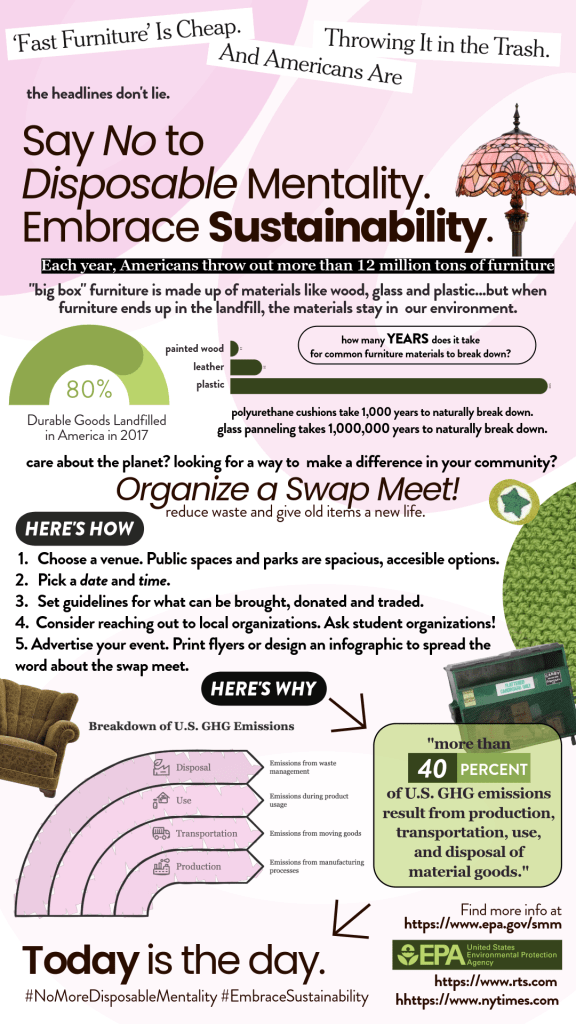
    5. Advertise! When it comes to swap meets, the more the merrier! So it’s important to advertise your event in a way that reaches a large audience and gets your message across in a way that’s accessible and inviting. One way to generate publicity for your swap is to create an infographic. An infographic allows you to put all the details in one place and easily send to friends and share over social media. 

    It’s priceless to see your old belongings take on new life and know that you gave back to your community, all while doing your part to practice climate conservation. 

    Check out this infographic to see an example of how you can use infographics to promote your swap meet and get your community excited about sustainability!

  • The Art of the Coffee Table Book.

    What makes a good coffee table book? They’re mysterious and expensive and totally unnecessary but also a staple in the home of every sophisticated adult. Whether you really are that sophisticated or just enjoy pretending to be, I’ve compiled a list of coffee table books that you might actually want to read! (Or just admire every time you walk past it.)

    The Book of Luck by Luna Knight. 

    This book is a charming almanac about all things fortune! It’s pretty informational and very cutesy–the perfect balance for a coffee table book. You can shop this book for $19.99 on Urban Outfitter’s website here.

    Virgil Abloh. Nike. Icons. By Virgil Abloh

    Remembered for his ingenuity and wonderful outlook on all things design, the late Virgil Abloh’s book on sneaker culture and his personal artistic process. You can order this book online here.

    Sofia Coppola Archive: 1999 – 2023 by Sofia Coppola.

    On the theme of visionaries and their creative memoirs, the Sofia Coppola Archive is the end-all-be-all for the film obsessed guest to read on your couch and a perfect excuse to make your friends download letterboxd. Plus, it’s an awesome shade of pink. Shop this book here.

    If you’re taking the fancy adult side of coffee table book shopping very seriously, a PRADA couture runway collection from Anthropologie’s Catwalk Hardcover Series could be the perfect purchase. 

    The series features designers like Chanel, Yves Saint Laurent, and Louis Vuitton, all with stunningly colorful covers. You can find them on Anthropologie here. It’s a bit on the pricier side for a college household, but would make for wonderful juxtaposition next to a pantry of top ramen and a 20 rack of keystones. 

    Little Book of City Style by Karen Homer.

    If you’re looking for something a little more pocket sized and wallet-friendly, these mini style books would make a fashionable addition to any shelf. Also found Anthropolie’s website, these little lookbooks feature street style from cities like London, Milan and Tokyo. An easy read and the perfect gift for your friend who just came back from study abroad. These little guys can be ordered online from Anthropologie here or on Amazon here!

    If these books don’t strike your interest or fit your budget, try purchasing second hand publications to assemble your own coffee-table library. Search for vintage magazines on Ebay or pick up local print from your favorite coffee shop.

    Magazines are also a cool way to tie in some personal interests that double as conversation starters for your guests. A personal favorite of mine is the Record Collector magazines. The publication has been around since 1979 and has been distributed worldwide ever since. Music magazines like these can be ordered off online sites like Etsy or you might get lucky and find a few free copies in some record stores! 

  • Print Your Own Posters

    Print Your Own Posters

    Step 1: Getting Started

    Ever wished your favorite underground band sold posters? Or have a recent obsession with an old movie whose merchandise is a collector’s item over 30 years old and going for over $50 on Ebay? With a quick Canva edit, Adobe render or scroll on Pinterest, you can hand-pick your image and create a poster the way you imagined! 

    Step 2: Where (and How) to Print Your Own Posters

    If you haven’t already, check out your local print and copy shop! If you’re a University of Oregon student like me, you can find my favorite print spot, (conveniently called The Copy Shop), at the corner of 13th and Patterson street. The Copy Shop offers a variety of services, ranging from wide format printing to vinyl decals. Though packing and shipping chains like FedEx are known to provide reliable everyday services, finding local print shops with more specialized services can inspire new projects and support local businesses. Plus, local shops often have discounts for students and are a great way to engage with the off-campus community. When printing with a shop, you can customize your print down to the size, finish and even request your print be trimmed to fit specific measurements. The Eugene location also offers banner printing, sticker making and heat transfers, all of which could help create custom merchandise to level up your clubs, Greek chapters or student organizations. You can find out more information on The Copy Shop website, here. Since discovering The Copy Shop my sophomore year, I have been back more times than I can count to print resumes, class projects and custom gifts for family and friends. 

    Back to the posters. 

    Step Three: Framing. 

    While I think most posters can stand on their own, (and am often too impatient not to tape them up the same day I purchase them), framing your wall art is a simple way to really elevate your space. However, frames are expensive. Mats are expensive. But neither of these things should stop you from displaying your art. With a bit of time and dedication to the sometimes-janky but very rewarding process, you can mat and frame your own art without breaking the bank. The best way to source inexpensive frames that match your taste is to thrift them. A trip to your local Goodwill or picking up a few $5 framed works from garage sales are wonderful places to look for frames at a fraction of the cost. Some frames come with mats, which you can swap out or repurpose. If you’re looking to do your own matting, bulk craft stores and discount department stores carry large sheets of poster paper in a variety of colors, texture, weights and patterns that can serve as makeshift mats for your artwork. The mat is not always necessary, but a wonderful way to bring some interest to your walls and make the piece more intentional. I suggest playing around with striped cardstock or a non-neutral color paper when trying out different matting. (You can always change this later.)

    Step 4: Hanging and Displaying

    Now for the fun part…putting the poster up! If your thrifted frame is in good condition, you should be able to display it with a few nails. But if your frame is missing some wiring or requires reupholstering, it may be a good idea to break out the command strips. For heavier pieces, I’ve found that the velcro command strips are the surest way to secure your frame while staying renter-friendly. It’s also fun to play with height and dimension, propping up framed artwork behind floor lamps or simply leaning atop a dresser. 

    Step 5: Celebrate!

    Experimenting with your home decor is one of the many joys of living in your own home for the first time. There is so much freedom in trying new things, changing your mind and changing it again. Stop by your local print shop; keep an eye out for funky frames on your next thrift trip. And when you’re feeling uninspired by your interior design setup, remember that thrifting and printing your own wall art is a great way to get creative with your space and your budget.

  • Sonically Shape Your Space

    Sonically Shape Your Space

    Most college houses are on the lower end of the square footage spectrum. But in a broke, music lover’s case, a smaller place can be a blessing in disguise. You don’t have to wait to thrift the perfect vintage armchair or to cash in on that Restoration Hardware coffee table to fill your home with things you love–put on your favorite album and enjoy your space.

    All sound systems are created equal (kind of)

    In my current room, I use the same Sonos One speaker I’ve had since highschool. It works wonderfully for my shoebox bedroom and I’m thankful every day to be able to turn on my playlist while getting ready for class or sitting in bed working on assignments. For the living room tv, my roommates and I use a Roku sound bar. Whether or not you’re big on movies, the soundbar provides great audio and has a feature which allows you to connect to the speaker through a phone. I’d never heard of the Roku brand before, but the sound bar was an affordable option, super easy to pick up from our local Best Buy, and has absolutely transformed our downstairs living and kitchen space.

    If you live with other music lovers who also don’t have the funds for surround-sound subwoofers, thrift a CD player! Decorate the player with stickers and store the CD’s in a bin or hat box to add a touch of early 2000’s charm to any room. Collecting discs can be a fun, ongoing roommate project that lets you share music with each other while saving some money. If you’re someone who is lucky enough to have a functioning record player and a collection of vinyls, you should totally, absolutely keep it downstairs–sincerely, the roommate who wishes she’d kept her millennial-teal player from middle school.

    If you have an instrument, display it!

    For those who enjoy playing music as much as they like to listen, bring out your gear for some functional decor. Set your beautiful leather clarinet case on a shelf instead of letting it collect dust under your bed. Mount your acoustic guitar to the wall or get a bass stand for the living room corner. You could even leave your amp on a bottom shelf or empty spot in a communal area, (just make sure to tidy-up the cords for your roommates’ sake). 

    Having one speaker, of any type or brand, in every room presents a world of opportunity. No one wants to live in a world without music, so you shouldn’t settle for a space without sound. One of the most important lessons I learned freshman year: don’t underestimate the JBL clip. Adding a bit of music can lift your mood, increase productivity, turn your space into an inviting hangout spot for friends to gather and complete your home. 

  • How To Separate Corporate CSR from Corporate BS?: Let’s Take a Closer Look at IKEA’s Sustainability Pledge

    How To Separate Corporate CSR from Corporate BS?: Let’s Take a Closer Look at IKEA’s Sustainability Pledge

    IKEA is one of the most reliable household names. Originating from Sweden and having expanded to more than 60 countries, IKEA has transformed the global market of affordable furniture, delivering a range of homeware products to fit every style and budget. The brand’s multigenerational customer base has established IKEA as a trusted brand for first-time homeowners and long-time customers alike. Specifically, the brand’s convenience makes their products a staple for college students everywhere…but how does IKEA’s values align with the culture of current undergraduate classes?

    Generation Z are not the only demographic concerned with protecting the planet, but the intersection of young adulthood and social media places them at the helm of the climate change discussion. Gen Z values and advocates for major corporations to adopt sustainable business practices, which is why brands like IKEA are taking consumer feedback and integrating conservationist practices into existing business models. 

    As a global brand, IKEA is influential to the international market. IKEA’s greatest claim to fame amongst the rise in sustainable movements from corporations over the past few decades has been its promise to be “climate positive” by the year 2030. But how can consumers follow along with IKEA’s developing climate-consciousness? How will this sustainability push affect the brand’s production? And what does “climate positive” mean, exactly? Many consumers don’t know where to look for answers to questions like these. Simply typing these inquiries into a search engine doesn’t usually provide detailed or thoroughly fact-checked answers. In this investigation of IKEA’s climate positive promise, I decided to begin at the source–IKEA’s website. 

    (P.S. “Climate positive” means not only achieving net-zero carbon emissions, but going as far as removing additional carbon emissions to offset harmful carbon dioxide from the environment.)

    In conducting primary research from IKEA’s website, it is clear that IKEA is committed to pursuing sustainability in a wide variety of forms. Their sustainability campaign is promoted through published articles and interactive tabs on the brand’s website, allowing IKEA to reach audiences who are curious about the company’s mission and are familiar with navigating the website.

    On IKEA’s website, there is a page dedicated to sustainability. This page outlines overarching brand goals and the steps IKEA is taking to turn these long term aspirations into reality. As detailed on the website, IKEA is working to achieve 100% renewable energy use through on and off-site generation. In 2019, IKEA published an article outlining their goal of climate positivity, investing 200 million euros to expedite the process. As a part of their campaign, IKEA is striving to adopt a circular business model which addresses environmental concerns by reducing waste and investing in products with longer life cycles. But they don’t stop there–IKEA is considering sustainability in how the company sources wood and cotton, partners with organizations like the Rainforest Alliance and Fair Trade and even increasing the plant-based food options offered in stores. The article concludes with a list of subpages with extensive information about IKEA’s policies and progress they’ve made towards missions surrounding biodiversity to human rights.

    When researching brand values and initiatives, it’s important to read beyond embellished phrasing and identify legitimate, quantifiable information. The clear, yet personal tone of IKEAs website effectively presents their plans to contribute to environmental conservation to their audience in a way that evades performative publicity and underscores their genuine commitment to each aspect of their mission. As IKEA continues on the path to climate positivity, they continue to successfully communicate the ways in which they’re evolving to reflect the modern values of their company and customers. 

    Additional Sources:

    IKEA: Our View

    What does “carbon positive” mean?

  • Housing Solutions for Students: Nonprofit Resources to Get You Started.

    Housing Solutions for Students: Nonprofit Resources to Get You Started.

    Finding affordable furniture and housing as a college student can often feel like an overwhelming, expensive challenge. With limited budgets and tight living spaces, students run into many new and confusing obstacles when navigating housing after moving out of their family homes. College is a time of growth and exploration, and it is important that students kick off their undergraduate experience in an environment where they can thrive. 

    Transitioning from dormitories to off-campus apartments and residential neighborhoods can be an intimidating step in a student’s college journey. Students don’t have to take this step alone. There are many resources dedicated to helping students take this step towards adulthood. However, creating a positive environment is not as simple as finding a property in a desirable location or with reasonable rent; A positive living environment is sustainable, comfortable and feels like home. If you’re in the process of making your own slice of home, don’t worry–there are resources for that too! Here are a few nonprofit organizations that can make the housing market seem less daunting and help you turn your house into a home.

    For many, finding a place to live can be a stressful and expensive process. Rent in college towns can be high, and securing affordable housing can feel nearly impossible, especially for students with limited financial resources. If you’re a student with sixteen over-budget Zillow listings bookmarked and no idea what to do next, you might want to look into the Street Homeless Advocacy Project/Student Housing Assistance Program, or SHAP. SHAP’s goal is to help students find affordable housing near their college campuses. The organization works directly with students to ensure they find financially realistic housing that doesn’t require them to sacrifice proximity to campus. Research your local SHAP organization to find out how they serve your community. Oregon residents visit this website to see how SHAP helps in-state residents: https://www.oregon.gov/ohcs/for-providers/pages/homeless-services-programs.aspx 

    Another organization committed to improve the learning and living conditions of college kids is a program called Believe In Students. This organization focuses on providing assistance to  college students who need support in meeting basic living expenses, including housing. Their mission is to ensure students can afford stable housing, so that they can focus on succeeding in school without the pressure of financial instability. Check out their website and see how Believe In Students can help: https://believeinstudents.org/about/

    In particular, Gen Z students are rejecting overconsumption and embracing sustainable lifestyle choices. However, these values can be hard to implement when navigating a housing market dominated by expensive and unsustainable options. Habitat for Humanity ReStores

     Is a nonprofit that recognizes the importance of accessibility and sustainability. Habitat for Humanity operates ReStores, which are nonprofit home improvement stores selling new and gently used furniture, appliances, and building materials at affordable prices. ReStores not only offers environmentally freindly furniture solutions, but uses their proceeds to fund their greater mission of building affordable housing. Visit their site and see how Habitat for Humanity ReStores contributes to environmental conservation and supports communities in need: https://www.habitat.org/restores

    Utlilizing  resources like SHAP, Believe In Students, and Habitat for Humanity’s ReStores can help you create a functional, comfortable, and eco-friendly living space to give you the support you deserve while earning your degree. Whether you are still looking for a place to live or beginning to build a home, remember that there are resources within reach. With determination and the right support, you can create a stable, sustainable environment to help you thrive.

  • A College Kid’s Guide to Facebook Marketplace.

    A College Kid’s Guide to Facebook Marketplace.

    After all of the packing, lease-signing and deep cleaning that comes along with the territory of moving, the most exciting step of settling into a new place is decorating it. But between tuition, textbooks, groceries, and back to school basics, most students are strapped for cash once it comes time to furnish their space. 

    This is why all students should explore Facebook Marketplace. Facebook Marketplace has it all–dining sets, side tables, quirky wall art, shoe racks, lamps–you name it. As a relatively new Marketplace user, I’ve already scored a beautiful Mid Century Modern four drawer dresser, and (my greatest Facebook Marketplace accomplishment to date) an almost new Ikea dining table with four matching chairs for just $60. Facebook Marketplace has completely revolutionized how I secondhand shop, and it can do the same for you, too.

    The range of homeware on Facebook Marketplace varies in condition and price, making it a one-size-fits-all platform for finding the right piece for your home. Fair warning, with the accessibility, impressive range and personalized feed, Marketplace can quickly become your favorite social media, (something I never thought I would say about Facebook). 

    For anyone who’s never considered buying from Facebook Marketplace, (or is too scared to try it), here are a few tips to help you score exactly what you’re looking for—and at a great price:

    Tips for Securing the Perfect Piece

    1. Use the “Like” feature: Liking a listing (even from out-of-state sellers) helps Facebook’s algorithm suggest items you might be interested in. This will help curate your feed based on your preferences. The more you engage, the better your feed will be at suggesting items you might love.
    2. Consider Condition: Facebook Marketplace is a resale platform, and secondhand items usually show sign of use from the previous owner. Check the product photos closely and always ask for additional photos or information about damage if it’s not clear. A little wear and tear can be part of the charm, but it’s important to make sure you know what you’re getting. 
    3. Don’t be Afraid to Ask: If you find something you like, but it’s slightly out of your budget, don’t be afraid to politely make an offer. Many sellers are open to negotiating and often appreciative of the fact that you’re a student on a budget. As long as you approach sellers with a reasonable offer, good communication and a kind attitude can sweeten the deal for everybody. 

    So you’ve found your perfect piece and now it’s time to bring it home. Good news-Facebook Marketplace is not only accessible, but built for safe, community engagement. Security features like the user’s ability to check for mutual friends and read through reviews minimize the risk and anonymity associated with other online buying/selling platforms like Ebay or Craigslist. However, taking extra safety precautions will ensure the transaction is as secure and comfortable as possible for both parties. Pick a good meeting spot. For example, meeting in a public place, like a well-lit parking lot or busy park is always recommended. Bring some company–if you’re picking up a larger item (like a couch or bookshelf), convince a friend with some free time to tag along. 

    Now that you know the ins and outs of Facebook Marketplace, you, too, can explore how rewarding it is to furnish sustainably, secondhand shop from your couch and build a curated home on a budget.

    Happy hunting, (and if anyone comes across a set of brass candle sconces, let me know).

  • Undergraduate Digest; An Unfiltered Look Into College Living.

    Undergraduate Digest; An Unfiltered Look Into College Living.

    Are you familiar with Architechtural Digest? This blog series is exactly like that! …just without the water features and imported Italian tiling or anything glamorous, at all really. But however un-glamourous, one’s college years are some of the most wonderfully unpredictable and exciting experiences for young adults. 

    We’ve since graduated from sharing a cramped dorm room with a roommate you barely know. Now, you’ve got your own space (or at least, your own corner of it), and the opportunity to transform it into your own little slice of home.

    Whether you’re moving in with a bunch of friends or finding yourself with roommates you barely know, living in a house during college is a unique mix of freedom, responsibility, and a few unexpected surprises along the way. Of course, with all that freedom comes a few challenges.  Moving is no small endeavor and living alone for the first time is an unforgettable experience. Most college students will leave their childhood homes to start a new chapter…in 8 x 11 ft rooms. Speaking for myself and my friends, the sense of freedom and novelty that came with first-year college living made up for the lack of personal space. However exciting, dorm rooms can feel temporary and not unlike sleepaway camp with bunk beds and dining hall food. Still, we cherished the shared hallways and limited functioning washing machines. 

    What makes a home? For college students it could be a hard earned beer can tower, a precious pottery barn hand-me-down or the facebook marketplace coffee table that’s seen it all. Though material items don’t define a home, they often have stories that give life to a new place. No matter how random or junk-filled, a person’s home is a wonderfully authentic snapshot of the stage of life they’re in. 

    It’s an opportunity to learn how to live with others, manage your own space, and create memories that will last long after graduation. I hope that in following along with this collection, you get a glimpse into the everyday lives of students in my college town and maybe even find some inspiration to bring back to your own home.